Most coaching programmes fail to demonstrate real impact beyond participant satisfaction, leaving their value open to question.
The typical approach:
The problem:
Your FD doesn't care if people enjoyed the sessions. They care if performance improved, turnover decreased, or revenue increased. Satisfaction surveys don't answer those questions.
The result:
Coaching gets treated as "nice to have" wellness spend, not strategic performance investment. Budgets get cut when times get tight. Renewals require re-selling from scratch.
You need better evidence.
Unlike traditional resilience training that places the burden on individuals, the RII measures resilience as partnership between what people bring and what workplaces provide.
Each dimension is grounded in peer-reviewed research linking it to workplace performance, retention, and wellbeing. Beyond mere satisfaction, the RII quantifies performance-linked capacity—measuring not just how people feel, but what they can actually do.
What people bring to workplace challenges
Recovery speed and steadiness under pressure—resilience is about bouncing back, not endurance
Staying composed and resetting after triggers—capacity to navigate emotions skillfully, not suppression
Drive to engage and capacity for action—early warning sign when energy depletes before coping collapses
Self-trust in professional capability—belief you can handle challenges, distinct from competence itself
What workplaces provide to enable or undermine capacity
Demands placed by workload, deadlines, systems—organisational responsibility for sustainable work
Clear goals, direction, and expectations—ambiguity wastes time, creates stress, undermines confidence
Whether role, culture, and work feel meaningful—strongest predictor of retention
Backing from managers, team, and organisation—people handle high demands IF supported
Each dimension measured through 3 carefully designed questions for a total of 24 questions total, completable in 10-12 minutes.
Low scores on organisational factors? Fix the system, not the people.
When your team scores low in areas like Stress Load, Priority Clarity, or Workplace Support, it’s not a sign they need more resilience training. It’s a sign your systems need fixing.
The RII results show how well individuals are coping and how the organisation supports them. If people’s ability to manage is generally good but the workplace environment is holding them back, this suggests where to focus efforts.
For example, if scores indicate that stress levels are very high, priorities aren’t clear, and support is lacking, it means the organisation needs to address these issues first. Trying to improve individual coping skills won’t be effective if workload pressures, communication, and support systems are not fixed.
In short, the results help identify whether it’s better to concentrate on improving the working conditions or on helping individuals directly.
The RII is a quick, private, and secure online assessment that measures individual and team capabilities across key dimensions, tracking progress and linking results to business outcomes.
15-minute online assessment
Participants complete 24 questions (3 per dimension) via secure platform. Takes no more time than a coffee break.

Timing
Scoring:
Each dimension scored 1-10 (10 = optimal capacity). Positively framed—we're measuring capability, not deficit.
Analysis:
Individual scores tracked over time. Team patterns identified. Correlated with business metrics you already track.
We don’t just track coaching improvements in isolation. We connect your team’s capacity scores with the performance data that truly matters to you.
Here’s how it works for different teams:
This approach gives you clear proof that coaching isn’t just about people feeling better. It shows measurable improvements on the numbers that drive your business.
For example: “When stress dropped by 30% and confidence rose 25%, closure rates jumped 18% and sick days fell by 40%.”
That’s real evidence your investment in coaching delivers.
What it takes: A genuine partnership. You share relevant performance data (always confidential and anonymised). We deliver quarterly reports revealing exactly how coaching impacts your business results.
The result: Hard facts on coaching ROI based on your own outcomes. No fluff. No vague claims. Just proof.
If you want to see coaching’s real value in your organisation – this is how it’s done.
Within two working days, every participant receives a concise 1-2 page report showing their scores across eight key areas—covering both personal resilience and the wider workplace environment. This report highlights their strengths, points out where development is needed, and offers practical coaching focus suggestions. The report is fully confidential and never shared with their employer.
As coaching continues, participants get simple, one-page progress snapshots that track how their scores change over time. These updates include tailored observations and reflections from their coach—again, completely confidential.
What this means for your people:
They gain clear, actionable direction on where to focus their efforts for real, measurable improvement. It validates what they’re doing well and helps them understand what’s within their control—and what comes down to the organisation itself.
You get a straightforward overview of team-wide trends across the same eight dimensions. This shows baseline data, progress over time, and highlights strengths alongside pressure points. Crucially, it separates issues caused by organisational factors (like workload or support) from individual development needs.
These include clear score trends, linked business metrics where applicable, easy-to-understand charts, and practical recommendations. The reports tell you exactly which issues need organisational changes and which can be addressed through coaching.

At the end of the programme, receive a full comparison from start to finish, a clear summary of return on investment, and insights into what improved through coaching versus what calls for systemic change. If follow-up assessments are done, you also get sustainability indicators and a case study narrative (with your approval).
What this means for your organisation:
You get hard evidence that coaching is making a difference—improving resilience, capacity, and business outcomes. You’ll know exactly where to invest to fix organisational problems versus where coaching can drive personal growth. This makes renewing or expanding your coaching programme an easy decision.
In short: The Resilience Impact Index™ gives you clear data that cuts through the noise. It’s a no-nonsense way to get measurable results for your people and your organisation—without jargon, guesswork, or wasted spend.
Final Report Including:
What this does:
Gives you board-ready evidence that coaching investment drives measurable capacity and business improvements. Justifies renewal and expansion.
Typical satisfaction surveys fall short:
Our RII™ approach changes all that:
Yes, we use self-reported data—because things like stress management and confidence can’t be measured any other way. But we don’t ask if people are simply ‘happy at work’. Instead, we assess solid, research-backed factors that predict actual performance and results.
When you combine our insights with your business metrics, the link is clear and undeniable.
This isn’t feel-good fluff. It’s about measurable improvement that genuinely matters to your organisation.
If you’re done wasting time and money on vague feedback and empty promises, this is the solution that actually works.
RII is included in every Lumarrae programme:
Our optional Partnership Model adds real value by linking your own business data to coaching progress.
This means you get clear evidence showing how coaching impacts your organisation’s results. It’s a standard feature in RADIATE corporate partnerships and an optional add-on for individual RESET or RISE programmes.

This is the right choice if you:
This isn’t for you if you:
You get straightforward insights, no fluff. Just evidence that coaching moves the needle where it counts. If you want to stop guessing and start proving your investment works, this is the solution.
Each RII™ dimension is grounded in published research linking it to workplace outcomes:
We're not measuring arbitrary dimensions. We're tracking capacity elements that research shows actually matter for performance—and critically, we distinguish what individuals bring from what organisations provide.
The RII is grounded in 24+ peer-reviewed studies spanning occupational psychology, performance science, and organisational behaviour research—including the Job Demands-Resources model, Self-Determination Theory, self-efficacy research, emotion regulation frameworks, and WHO guidelines on workplace mental health.
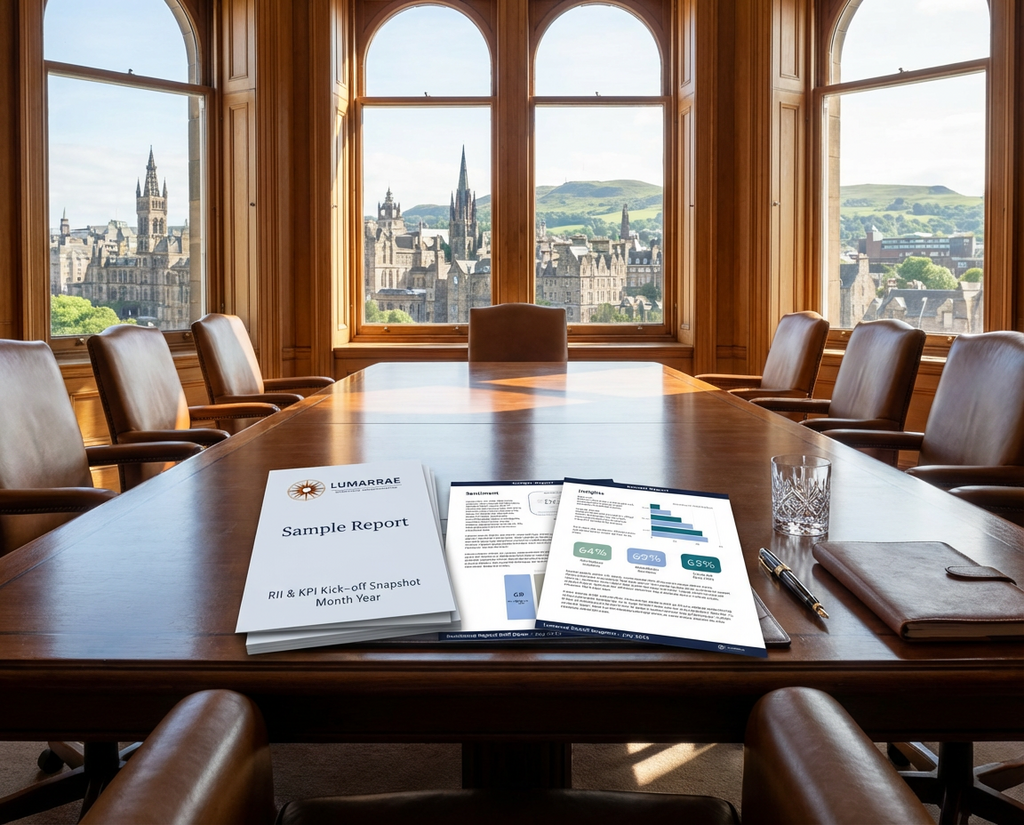
Download a sample report to explore:
A: No. While the RII uses self-reported data (like all psychological tools—you can't objectively measure internal states like stress coping capacity or confidence), we're measuring evidence-based capacity dimensions that predict performance outcomes, not just "did you enjoy the coaching?"
The difference: typical surveys ask "are you happy?" We measure stress coping capacity, emotional regulation, motivation & energy, and confidence (individual capacity) plus stress load, priority clarity, workplace satisfaction, and workplace support (organisational context)—dimensions research shows correlate with retention, productivity, and effectiveness.
Plus, when we overlay RII data with your business metrics (partnership model), self-reported capacity changes are validated by objective performance improvements.
A: We tested multiple configurations during development. Eight dimensions (4 individual capacity + 4 organisational context) achieves perfect balance—preventing resilience weaponisation while remaining comprehensive yet efficient.
The 4+4 structure embodies our "resilience takes two" philosophy: resilience is partnership between what individuals bring and what workplaces provide. Equal weighting prevents organisations from using the RII to say "your employees need more resilience training" when the real problem is excessive workload, poor communication, or inadequate support.
Each dimension is distinct (no redundancy), improvable through coaching, and directly linked to business performance. More dimensions would create survey fatigue; fewer would miss essential aspects.
A: Engagement surveys measure how people feel about their employer. The RII measures their capacity to perform under pressure—and critically, distinguishes individual capacity from organisational context.
These are related but distinct:
The RII shows WHERE to invest development resources for maximum performance impact, and WHAT requires organisational change vs coaching intervention.
A: Then we have honest data showing the intervention didn't work as expected, and we adjust our approach. We'd rather know the truth than pretend everything's great. That's why we track at baseline, midpoint, and endpoint—so we can course-correct if needed.
Also worth noting: business metrics are influenced by many factors beyond individual capacity (market conditions, organisational changes, team composition). The RII helps isolate capacity from those external factors. If capacity improves but performance doesn't, that tells us something important about organisational barriers blocking that capacity from translating into results.
A: No. Individual RII scores and personal insight reports remain strictly confidential between participant and coach.
Organisations receive only anonymised, aggregated data showing team-wide patterns. We require a minimum cohort size to protect individual privacy. If you want to see individual scores, participants must provide explicit written consent.
A: 10-12 minutes. 24 questions (3 per dimension). Less time than a coffee break.
A: Not a problem. We can work with whatever you DO track—even basic metrics like absence rates, turnover, or manager feedback can show correlation.
The partnership model is most powerful with comprehensive data, but it's not all-or-nothing. We adapt to what you have available.
A: Yes. The partnership model (correlating with business metrics) is optional for individual RESET/RISE programmes.
All programmes include standard RII assessment with individual participant reports and team dashboards. The business metric correlation is a value-add that requires data-sharing partnership. For RADIATE corporate partnerships, the partnership model is standard inclusion, but we can leave it out if you prefer.
The RII TM is included in all Lumarrae programmes so if you're exploring RESET, RISE, or RADIATE, you'll get it as standard.
Interested in the Partnership Model, with or without one of our programmes? We can do that as well.
Simply book a consultation below and we'll discuss your needs so that we can tailor a proposal to your specific use requirements.

Just want to see a sample first? Download our sample RII TM report to see exactly what you'd get.
Performance Coaching for High Pressure Environments